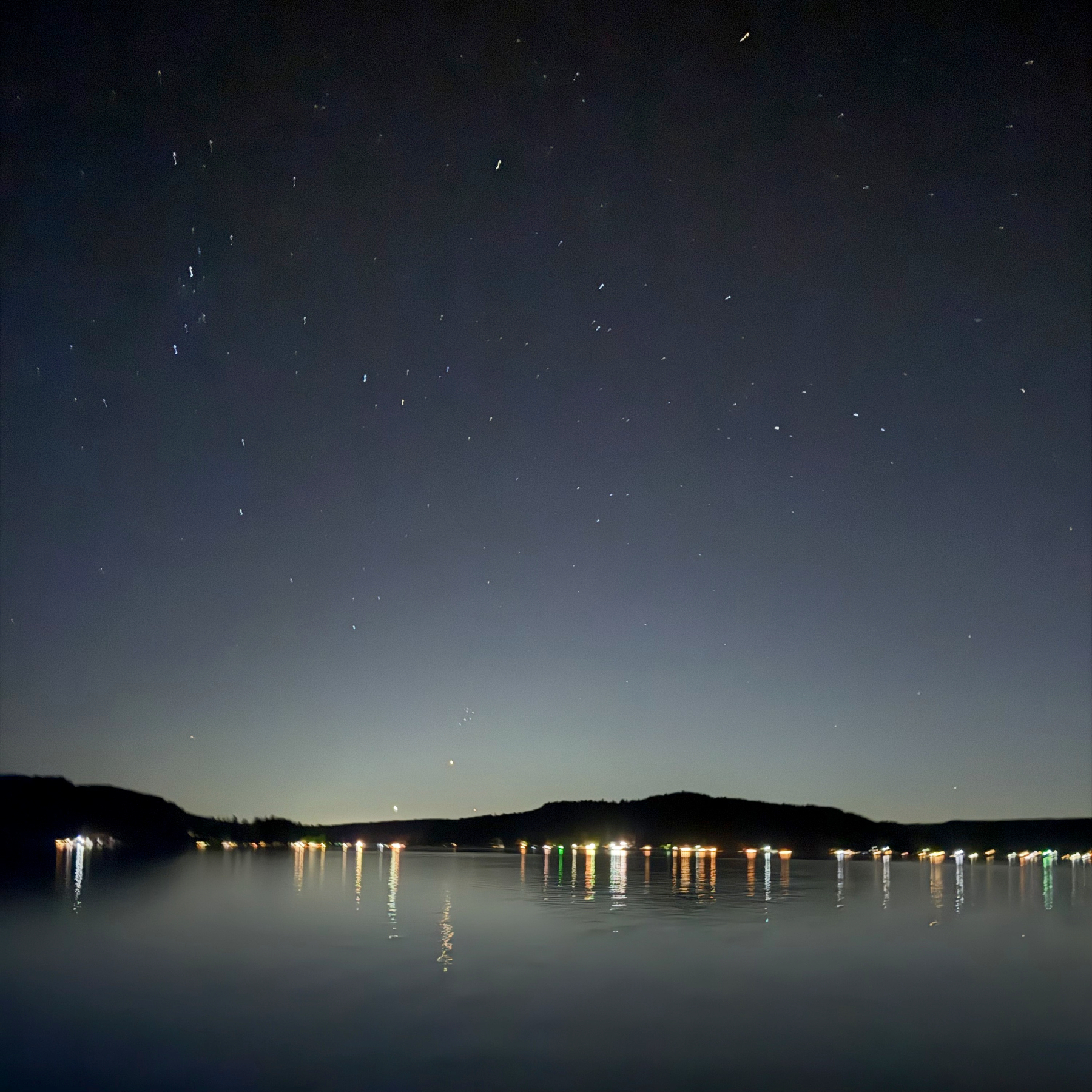
I took this shot of the stars from Puget Sound a few days ago, then didn't even look at the result on my phone because I just assumed it would be blurry. Actually it turned out pretty neat. If I had known, I'd have tried again and fiddled with the exposure.
I’m curious what makes writers choose a particular format for an idea? (e.g. blog post versus comic versus zine versus poetry)
how much of working in a format is learning what ideas suit it, and figuring out an approach to starting a piece in that format? (e.g. I wouldn’t know how to approach writing a poem)
James mentioned “remixing” several blog posts into a new post — I might try this to extract good ideas from old, not-that-good posts I wrote in the early years of this site that I don’t want to link to 🤔 (Joe described this as thinking of “your own output as a kind of library”)
I realized that when writing a new post, I lean on hypertext and tend to reference previous ideas very briefly with a link — but that it might be more useful (both to readers and myself) to reiterate the point succinctly — as writers, we may be overcautious of repeating ourselves; readers might even appreciate refreshers.
Michael referenced McLuhan as saying that the most successful texts only contain 25% new ideas 👀
To transform a series of blog posts into another format like a zine or ebook, the hypertext would need to be integrated (I find following links obnoxious on my e-reader) — that might mean rewriting text to expand links into text describing their ideas, or moving those references into footnotes / endnotes
for a zine you would want to simplify and shorten the text, whereas an ebook would allow for expansion
I don’t consider the tone of a blog post when I’m starting to write it, but maybe I should… I realized that I’ve been writing around several ideas over the past few months, and that the biggest problem I’ve found is that the tone is not right.
One example: there has been a lot of brouhaha about the death of literacy over the past year. I’ve written at least three attempts in different tones — analytical, emotional, confidential — none of which fully reflected what I felt. I think maybe I don’t actually need to weigh in 😉
So the wall-mounted version, when you include a mount, costs more but sounds worse? This doesn’t make sense.
I was thinking about this too. All I can come up with is that Apple doesn't want you to buy the wall-mounted version unless you're really sure that's what you need. If the wall-mounted version was cheaper, some people might buy it based on price, then be unhappy because it's too much trouble to install.
No wi-fi and intermittent cell coverage for this trip, as expected. Somehow I managed to upload a video when we got back near a town. I used the offline time to write some code by hand (gasp!) and do yet more editing on the book.
We’re down to the final four segments, but we only have three walks left to do. The plan for today is to walk segment number 7 and also attach to it the beginning part of number 8. 23km, 870m of ascent, 1250m of descent. Next time, we’ll finish 8th and attach 9th to it, but that’s a problem for future me.
I’ll be honest with you, I’m kinda tired of these walks. Especially because this second half stretches across trails I walked countless times before. But I also want to walk the whole loop and visit all these churches, so we won’t stop here.
But we’ll move fast this time around. There’s no point in taking a million pictures at this point. The scenery is mostly the same, the overall area is still the same, so we might as well use this as an opportunity to do some cardio training.
The humidity is very high early in the morning, but it’s gonna get warm fast. The trail is gonna take us down for a bit, then back up, then all the way down next to the Slovenian border, all the way back up again, and the final stretch is gonna go down again, to the final church of today’s walk and also my car, since it’s parked right next to it.
First stop is gonna be the church of San Giovanni Battista (29/44), and on our way there, we see the church of San Paolo Apostolo far in the distance. It would be part of this segment of the loop, but we visited it on my previous walk, as I was walking all the way back to my car.
The church of San Giovanni Battista is in an amazing location, and out of the 44, this one’s probably the one I’ve seen the most throughout the years. There’s a lovely short loop that I often walk with the dog, and the view from up here is great.
Almost exactly an hour in, and we have reached the first POI I have marked on the map. I’m pleased with the pace so far; this is enjoyable.
I’m starting to walk down the trail I mentioned a moment ago when all of a sudden a formidable foe blocks my path: a herd of goats. Well, maybe herd is a bit of an exaggeration since it’s only 6 of them. But these were just out on their own—and were shitting everywhere—and not only did they have no intention to move away from the trail, one of them was not in the mood to let me pass.
Love goats, they’re fun. But can also be jerks, and the last thing I need is to find myself fighting a bunch of goats on a rocky trail. Plus, there’s a very convenient alternative trail just around the corner, so better to leave these alone.
Down, and down, and down we go, through the woods, without ever encountering a single soul. That’s honestly the best part about walking these trails: it is incredibly rare to see people. It’s just me and nature. And goats, I guess.
Through a couple of small villages we go—not a single human being in sight—and around the second church of the day, the church of San Bartolomeo Apostolo (30/44) that sits maybe a few hundred meters from the Slovenian border. We’re just a bit more than 2 hours in, and we have already walked half the distance. But we still have most of the uphill part to walk, so we’ll see if we manage to keep up the pace.
Up, and up, and up we go. And up and up the heartbeat also goes. But on our way up with pass next to the third church of the walk, the church of San Tommaso Apostolo (31/44).
There’s a house for sale literally right next to the church if you’re interested. Also another one for sale maybe 30 meters before it. If you like quiet places, this is the location for you. In the middle of absolutely nowhere. We’re not even a quarter of the way through this uphill section, so we better keep going.
Less than three hours into this walk—and almost 16.5km—we have reached the fourth church of the day, the church of Sant’Antonio da Padova (32/44).
This is another one I have visited a bunch of times before, so no point in spending time here considering we still have the last uphill stretch to finish. I knew this was the last challenging part, so it was fun to keep pushing, and I think I peaked at 168bpm. But it’s gonna be almost entirely downhill from now onwards.
We take a quick detour to hit the fifth church of the day, the church of San Nicolò (33/44).
I wrote about this one in a previous edition of From the Summit. Another one of those churches I visited a lot over the years because it’s another place I walk often with the dog.
This would have been the final church of the day, and the normal route would take me west. But we’re going east, and then cut down through the forest to reach what would be the first church of the 8th segment. As predictable, this alternative path takes me through a trail that is overgrown but, oh well, who cares.
Wonderful location, with Mount Matajur always in the background. I have to admit that a few of these churches are placed in lovely locations; this is like the perfect spot to just chill and read a book on a sunny day. I might come up and do that soon; I ordered a bunch of new books just the other day.
Final stretch, only a bit more than 1km left to walk and then we’re done for the day. Risked falling on my back on a very slippery and steep part of this final stretch but thankfully I still have good reflexes. A bit more than 4 hours in and we have arrived at our final destination, the church of San Leonardo Abate (35/44).
I have to say, going fast made this walk a lot more fun. I might do it again. I’m glad we’re down into single digits; I can smell the end of this loop. And after that, we can focus on walking other places and see things that are not churches! As always, if you want to stalk my walk, here is the data recorded by my watch.
See you next time.
You love the outdoors and RSS. You're one of the special ones.
(Technically: self-reported ASMR correlates with a shared EEG biomarker, but it doesn’t demonstrate the reverse – i.e. this does not yet show how to build an ASMR detector.)
Always interesting how words and politics amplify/inhibit technologies and ways of thinking.
e.g. in this paper, a quote from the 1970s:
“Can human build intelligence? No. The term ‘artificial intelligence’ is easy for idealists to exploit. If humans can build ‘intelligence,’ then, in the future, something more intelligent than humans will emerge. … Some Soviet revisionist academicians are vigorously propagating AI. This behavior fully exposes their ugly face as traitors.”
HOWEVER,
I am most particularly tickled by this anecdote:
In the early 1980s, the misunderstanding about AI lead many people to an idea that associates AI with the so-called “exceptional human body functions”, which refers to some unscientific, unproven, imaginary, supernatural functions of human body such as extrasensory perception (ESP), telepathy, and moving things with mind. This fervor stemmed from a news report in March 1979 on Sichuan Daily, a local newspaper in Sichuan Province. The report was about a boy named Tang Yu who were claimed to be able to read books using his ears. The news caused a sensation.
Huge if true.
3.
Every so often I remember this story about Jacques Derrida related on X nee Twitter and can’t stop laughing. Copy-and-pasting it here for posterity.
A professor of mine went to go hear Derrida speak once. The entire talk was about cows; everyone was flummoxed but listened carefully, and took notes about…cows. There was a short break, and when Derrida came back, he was like, “I’m told it is pronounced ‘chaos.’“
4.
The argument in From Newspeak to Cyberspeak (Slava Gerovitch, 2004) about why Soviet Cybernetics didn’t invent the personal computer, as previously mentioned:
the political insistence on materialism stripped cybernetics (and therefore computing research) of metaphorical yet inspirational ideas like “memory” and “learning”, constraining the vision of computing to simple calculation.
The human elements were translated away. So the metaphorical leap to “hey maybe computers could be bicycles for the mind” was just too far.
You know memory was controversial in English too, once upon a time? Like, computer memory.
May I suggest that a protest is overdue against the anthropomorphic character of the terminology that is being applied to electronic digital computers? To the layman the use of such a terminology seems to ascribe human or near-human properties to these machines.
That’s a letter to Nature.
I can’t read the full letter right now (please do send me the PDF if you can) but Kapp objected to the terms: memory, instruction, information, machine language and decision.
The argument settled quickly: memory stayed as the adopted term.
And then a backwash effect: people now often imagine human memory as working like computer memory, a box that you put things into and take things out of, which isn’t the case at all. The metaphor became the exemplar.
So I think about that, while we’re talking about “training” and “hallucinating” and “thinking” with our LLMs. It’s not true, anthropomorphising an AI as a lil guy is so misleading: you type something into a window, a rack of GPUs in West Virginia is lit for a nanosecond with the energy density of a small star, a wavefront of computation sweeps across electron surfaces that holographically encode the entire record of human culture at the speed of light, focusing into a single beam that spits a stream of tokens down a fibre onto your screen. And then it does the same for someone else.
Let’s use those human terms anyhow. It’s not like we have anything better. And they might help with with the next metaphorical leap to what these AIs really are.
(And then I wonder what the backwash is, how it will change how we narrativise ourselves.)
I wrote software for a living for a long time. Speaking for myself, I can confidently say that Claude Code writes code that's so much better than mine that it's embarrassing. I've gotten over it. I'm not a craftsman. I wish I was, but honestly I just want to tell the computer what I need done and have it do it. I suppose that's really all I've ever wanted. Now I can, and it's thrilling.
That Tesla Roadster demo was a pretty cool stunt. Cool, but dumb. And only a stunt.